Tuesday, June 7, 2016

Fern Vilate Brown Hyer: A Narrative Genealogy - Part 1 Nauvoo

How it came to be that George Andrew Brown, a Mormon, was in the right place at the right time to meet, court and marry Ruby Vilate Spilsbury, also a Mormon, so that they could have a daughter named Fern Vilate Brown (my mother) is a long and complicated story, but here are the essential elements (and this may take more than one blog post):

George and Fanny Spilsbury

In 1842 a young 18-year-old girl named Fanny Smith living in Cradley, a village in Herefordshire in the West Midlands of England, was invited by some of her girlfriends to go with them to hear “some funny men from America” preach about a “gold bible.” It was a lark, a chance for a little fun watching these silly people. And, being teenagers, it was also a little act of rebellion. Their local Church of England minister had told all to avoid the Mormon missionaries. The wrath of that minister, and likely their parents, would come down hard on them if they were found out. Fanny and her friends went giggling to the meeting that evening. As the meeting unfolded, however, Fanny did not find the missionaries laughable or their message funny; she was not amused but interested, experiencing a feeling of “peace and hope” and being “touched to the depths of her soul.” She sought out these missionaries to learn more about this religion and, becoming convinced of its truthfulness, was baptized. To avoid persecution and harassment the baptisms were done at night at a secluded place on a river. On the evening Fanny was baptized it was so cold that the ice on the river first had to broken by one of the missionaries, a young man named George Spilsbury.

This missionary, George Spilsbury, from Leigh Parish in the neighboring shire of Worcester, was himself only 19 years old at the time and had only been a member of this church for less than two years. George was a bricklayer and plasterer with his father. The family were devote members of the Church of England. When he was 16, however, George had had a remarkable experience where, while resting under a shade tree, a voice came to him saying, “you will become a preacher of the Gospel.” George thought the experience strange since in the Church of England you were not allowed to preach unless trained for it and, as a practical matter, that training was not open to George. A few months later he attended a meeting and heard some Mormon missionaries from Utah in America preach. After more meetings and study he became convinced of the truthfulness of this message and was baptized a member on October 11, 1840. Two months later he attended a conferenced presided over by Brigham Young, then the leader of the British Mission. After the conference, at Brigham Young’s direction, he was conferred the Aaronic Priesthood and ordained to the office of a Priest and shortly afterwards called on a mission to teach this gospel. He and two others then spent the next year traveling by foot in Herefordshire and Wales preaching this gospel. George baptized 17 souls into this church, including Fanny.

Fanny and George later became better acquainted, fell in love and decided to marry and follow the Prophet Joseph’s call to gather in Zion – Nauvoo, Illinois. This was not an easy decision. Both of their families objected to this new religion and considered their desire to join these Mormons in Zion foolish and imprudent, but it was especially difficult of Fanny. Fanny’s father was a tailor and solid member of the growing English middle class. Fanny’s mother had died a few months after she was born. With her mother gone, her father had lovingly doted upon her. He had hired a housekeeper, mostly to train Fanny in the art of being a refined and cultured English lady. There was also a young male admirer, suitable middle class, but whose affection she had not then reciprocated. This was a promising future for a young middle class English girl to walk away from. Fanny had been baptized in secret because she had expected her father would disapprove. She was right. He strongly objected to her involvement in this church and her marriage to George and their plan go to across the ocean to join other members in this “Zion” in America. Her father declared that she was “a bamboozled fool and would be sorry” and further ordered that until she realized it herself she was not to enter the home and was not allowed to take any of her things from the house.

George and Fanny, however, had made their decision and weren’t looking back. They were married on September 5, 1842. Fanny went to work as a milliner and George went back to working in his trade and in a few months they had saved enough for passage to America. Finally, on March 8, 1843, they left Liverpool on the Yorkshire for America. After a difficult and perilous voyage they arrived in New Orleans and made their way up the Mississippi to Nauvoo arriving on May 31, 1843, absolutely penniless. However, with George’s trade and with Fanny helping out with sewing where she could they soon began to settle in with the Saints in Zion.[1]

Samuel and Lydia Brown

When Fanny and George Spilsbury arrived in Nauvoo 1843 there were also some others in Nauvoo who are important to this family history, including a shoemaker named Samuel Brown and his wife Lydia Maria Lathrop. Samuel was from New Hampshire, where he was born in 1801. When he was 29 he met and married an English girl named Harriet Cooper. They had a son named Samuel, Jr. Harriet died shortly after the baby’s birth. Samuel, then a widower with a small son, accepted the gospel message from some Mormon missionaries and immediately joined the main body of the church then in Kirtland, Ohio. He was one of the faithful. He was part of the Zion’s Camp trek to Missouri in 1834, and he helped in building the Kirtland Temple. While serving as an usher at the temple he met Lydia Maria Lathrop, who was also working in the temple. 

Lydia was a fourth great-granddaughter of the Reverend John Lathrop, the immensely influential Pilgrim minister in New England. Not surprisingly, she was a refined, religious woman and schoolteacher and also an excellent seamstress and glove maker. Her father Grant Lathrop and her mother Sybil Bliss had been married in Connecticut. They continued to live in Connecticut and had six children, including Lydia. Grant, however, died in 1823. The then widow Sybil and her family moved with her father to the Palmyra, New York area. They were in this area in 1830, just in the right time and place to hear about Joseph Smith and this new religion. Sybil and three of her children, including Lydia, joined the church and then followed the Saints to Kirtland, Ohio. There, while working in the temple, Lydia met this widower Samuel Brown and his five-year-old son Samuel, Jr.
Samuel and Lydia were married in 1837, with Lydia becoming a mother for Samuel, Jr. Samuel and Lydia were witnesses to the marvelous spiritual experiences of that temple’s dedication, but they were also witnesses to the apostasy and dissension within the church and persecutions that shortly followed. They, however, remained faithful and followed the main body of the saints to Missouri. But in Missouri they found only find more dissension and persecution. Fleeing the persecution in Missouri, the Browns had gathered with the other Saints in Nauvoo, Illinois.[2] 

John Lowe and Caroline Skeen Butler

John Lowe Butler and his wife Caroline Skeen Butler and their family were also in Nauvoo at this time. The Butler and Skeen families had lived within a few miles of each other on the Tennessee and Kentucky border. Both families were early and prominent settlers in the area and were well acquainted. The Skeens were slave owners. John, then a tall handsome 22-year-old young man, was a teacher, blacksmith and farmer, but suffered from bouts of rheumatic fever which often left almost wholly incapacitated. John married Caroline Skeen, an attractive southern belle, in 1831 in a wedding linking these two prominent area families. Caroline’s father, Jesse Skeen, a moderately wealthy plantation owner, gave the couple three weeding gifts – an expensive sidesaddle so Caroline could ride in a style proper for a well bred southern woman and two slaves. Caroline had grown up being served by slaves and the family tradition was that until her marriage she had never combed her own hair. The slaves would allow her to continue that lifestyle. The Butlers, however, although having lived for years in slave states, did not believe in slavery and had never owned slaves. John and Caroline graciously accepted the gifts but then shortly after they freed both the slaves, much to the displeasure of Caroline’s father.

During John’s frequent periods of illness he would often think deeply about religion. This search included profound personal struggles and prayers. He had been disappointed with the strife and confusion among the various sects in the area and had found them all lacking. John recounted that on one occasion while praying alone in a field a voice spoke to him saying, “stand still and see the salvation of God and that will be truth.” He said he was then content to let the truth find him.[3] In 1835 Mormon missionaries came to the area. John and Caroline listened to their message. Thinking of his earlier experience, John recognized their message as a fulfillment of that promise. When he asked Caroline about her thoughts on the missionaries, she said she thought, “they were men of God, and that it was the only true church of God and the only way to be saved.”[4] John and Caroline were baptized March 9, 1835. Following their baptism they endured bitter persecution from ministers, neighbors and friends and, sadly, most harshly from Caroline’s own father, Jesse Skeen. Skeen was bitterly opposed to Mormonism, spread false, but especially vicious and scandalous, rumors about the couple and the Mormon missionaries. After enduring this persecution for a year, John and Caroline and their family left Kentucky in March 1836 and joined the body of the saints in Missouri. There they suffered with the Saints the Missouri persecutions and depredations and fled Missouri for Nauvoo, Illinois in 1839. The Butlers would have 11 children, but the third, a daughter named Keziah Jane, born on February 25, 1836, during that difficult year in Kentucky following their baptism, is the most significant to our story.[5]

John Hardison and Elisabeth Hancock Redd

There was also another southern family important to our story visiting in Nauvoo at that time, John Hardison Redd and Elisabeth Hancock Redd. The Redds were originally from Onslow, County, North Carolina, where the Redds and Elizabeth’s family, the Hancocks, were prominent and financially successful members of the community. Elizabeth was a descendent of John Hancock, the one with the bold signature on the Declaration of Independence. As part of the westward growth of the country, John and Elizabeth and their family moved to Murfreesboro, Tennessee in 1838 and purchased a large plantation and along with a few African American slaves to work it. At the time of this move John and Elizabeth had six children, including a then two-year-old son named Lemuel, who is particularly important in our story. Four years later the family was taught the gospel by John D. Lee, a powerful Mormon missionary who would later become a prominent church member. John and Elisabeth accepted the gospel message and were baptized and confirmed members of the church. Southerners at that time were not particularly welcoming to Mormons and the decision to join the church took some courage. They came to Nauvoo to meet Joseph Smith and receive patriarchal blessings by Hyrum Smith. Following his conversion, John freed his slaves by an act of court and made a financial provision for each. However, two of former slave women, Venus with her son Luke and Chaney her two daughters Amy and Miranda, decided to stay on with the family.[6]


[1] Nelle Spilsbury Hatch, Mother Jane’s Story (Shafer Publishing Company, Inc. Wasco, California 1964) 65-72; MayBell Harmon Anderson, “ Fanny Spilsbury Story,” undated history available at familysearch.com under the stories entry for Fanny Smith (LHZS-YLB).
[2] Irene Brown Martineau, “Samuel Webster Brown 1801 & Lydia Maria Lathrop 1815,” undated history available at familysearch.com under the entry for Samuel Brown (KWJX-SDP); Emily Brown Hatch, “Lydia Maria Lathrop Brown 1815-1852” undated history available at familysearch.com under the stories entry for Lydia Maria Lathrop (KWJX-SDG); Ruby Brown Bradfield and Della P. Ware, “Samuel Webster Brown,” (undated history available at familysearch.com under the stories entry for Samuel Brown (KWJX-SPD)); Mavis Buchanan, "Pioneer Sybil Bliss Lathrop Jacobs and her Pioneer Family,"(undated available at familysearch.com under the stories entry for Sybil Bliss L44V-15Z)).
[3] Hartley 23
[4] Hartley, 25.
[5] Hartley, 28-31; “John Lowe And Caroline Skeen Butler — Of Courage And Faith,” 3-11 (This unpublished manuscript is included in “Redd Review,” a compilation of Redd family histories made in1996 and is available at familysearch.com in the documents section for John Hardison Redd KW8Z-7GX); Hatch, 7-10.

[6] Hatch, Mary Jane’s Story, 6-7; Lura Redd, “John Hardison And Elizabeth Hancock Redd,” 46-60 (This unpublished manuscript is included in “Redd Review,” a compilation of Redd family histories made in1996 and is available at familysearch.com in the documents section for John Hardison Redd KW8Z-7GX); Nelle Spilsbury Hatch, “Lemuel Hardison Redd,” in “Stalwarts South of the Border,” compiled and edited by Nelle Spilsbury Hatch and B. Carmon Hardy (published 1985) 559-563. The Redds never actually reside in Nauvoo. After meeting Joseph Smith and receiving these blessings they return to Tennessee, sell their plantation and leave from Tennessee to join the Saints in Missouri for the move west.

Friday, June 3, 2016

Missouri Mormon War - Battle of Gallatin

Adam-ondi-ahman

August 6, 1838, was another hot day in what had been a hot dry summer in Gallatin, the county seat of Daviess County in northwestern Missouri. It was also Election Day and tempers were running as hot as the weather. Although Gallatin was blessed with rich soil and water and agricultural promise, it had not been until 1831 that the first settlers, mostly southerners, came to the area, eventually forming a small community named Millport in 1836 on the east bank of the Grand River. In 1837, the Gallatin settlement was established, a few miles away on the west side of the river and became the county seat.[1]

For members of the Church of Jesus Christ of Latter-day Saints, the Mormons, this was a time of turmoil. The Mormons had established two principal gathering areas in Kirtland, Ohio, and Far West, in Caldwell County in Missouri. Driven by persecution by outsiders and from dissenters within, those in Ohio had abandoned their Temple in Kirtland and were fleeing to Missouri. Mormons had earlier also settled further south in western Missouri in Independence, but had been driven out by persecution to settlements farther north in Caldwell and Clay counties. Now those that had settled in Clay County were again fleeing and seeking refuge in Far West. With these displaced Mormons from Clay County, Missouri, and Kirtland, Ohio, all coming into Far West in Caldwell County, Missouri, the Prophet Joseph Smith was looking for additional places for the Saints to gather and Daviess County was a promising location. The Prophet Joseph had identified a place a few miles from Gallatin in 1838 as “Adam-ondi-Ahman, the place where Adam blessed his posterity after leaving Garden of Eden and where Adam will return prior to Second Coming.[2] On June 28, 1838, the Adam-ondi-Ahman stake was formed and the place was declared a settling place for the Saints.[3] Within a few months that “beautiful country … drew in floods of [Mormon] emigrants [and] there “were upwards of two hundred houses built in this town [Adam-ondi-Ahman], and also, about forty families living in their wagons.”[4]


In contrast, Gallatin, although established a year earlier, still wasn’t much of a town - a row of four houses and several saloons. Not surprisingly, the original settlers, most of whom were southerners, were concerned about losing political control to the Mormons, a people and religion they generally despised and, in any event, many of whom were northerners. At the time the two political parties in the county were fairly balanced, such that the vote of the newly arriving Mormons could swing an election, giving Mormons, who often voted as a block, considerable political power.[5]

William Penniston, a prominent citizen representing the views of the original settlers, was a candidate for the state legislature. Having previously led a mob trying to drive the Mormons out of Daviess County, Penniston was hardly expecting any Mormon support and so had an alternative plan. On the Election Day about 200 non-Mormons, largely original settlers, had gathered at Gallatin for the purpose of preventing the Mormons from voting. Penniston stood up on a whiskey barrel and gave an insulting rant against the Mormons, saying among other things that the “Mormon leaders was a set of horse thieves, liars, counterfeiters” and that they “profess to heal the sick, cast out devils …  and you know this is a damn lie [and that if] we suffer such men as those to vote, you will soon lose your suffrage [and that] Mormons had [no] more right to vote than the damned niggers.”[6]

By that time about 30 Mormons had arrived at the polling place to vote and although little was said the situation was tense. Then:

[A] drunken brute by the name of Richard Weldon, stepped up to a little Mormon preacher, by the name of [Samuel] Brown, and said: “Are you a Mormon preacher, sir?”

“Yes, sir, I am.”

“Do you Mormons believe in healing the sick by laying on of hands, speaking in tongues, and casting out devils?”

“We do,” said Brown.

Weldon than said, “You are a d—d liar. Joseph Smith is a d—d imposter.”

With this, he attacked Brown, and beat him severely. Brown did not resent it, but tried to reason with him; but without effect. At this time a Mormon, by the name of Hyrum Nelson, attempted to pull Weldon off of Brown, when he was struck by half a dozen men on the head, shoulders and face. …  Immediately the fight became general.”[7]

This Samuel Brown was a New Englander, a shoemaker, who had joined the Saints in Kirtland shortly after his baptism in New Hampshire. He was not a tall man, was neat and clean, and walked with a slight limp due to a deformity in his heel. He was among the most faithful, having worked on the Kirtland Temple and experienced the marvelous blessings of its dedication. He had been a member Zion’s Camp that marched from Kirtland, Ohio, to Jackson County, Missouri, to aid the Saints. And he was indeed a preacher. He had served several missions and he had been called to the First Quorum of Seventy. Notwithstanding the dissension and persecution in Kirtland, he and his wife Lydia Mariah, another faithful Saint and fellow New Englander and incidentally a fourth great granddaughter the influential Pilgrim Reverend John Lathrop, had followed the Prophet Joseph Smith’s call to leave Kirtland and come to Missouri. On the Election Day, he came to vote even though he was still sick and recovering from an illness.[8]

With the non-Mormons pummeling their fellow Saints other Mormons, although vastly outnumbered, came to their defense, including a Mormon named John Lowe Butler. Butler was from Kentucky and he and his wife’s families were among its early frontier settlers. Butler, a schoolteacher, had received the Mormon missionaries in Kentucky where he and his family were baptized and confirmed members of the church. At the time of his baptism, John was essentially an invalid with a shrunken body and suffering from rheumatism. After baptism and several priesthood blessings, he was healed and grew in size and strength. At the time of this Election Day he was a large, strong man of about six feet two inches with broad shoulders.[9] He also worked as a blacksmith. At that time the South was not an easy place to be a Mormon and, after having endured the persecution of their neighbors and family in Kentucky for a year following their baptism, the Butlers had recently joined the Saints in Missouri.[10]  He had come to Gallatin with the other Mormons to vote. This is how Butler described what then happened:

I went to where the affray was and saw they had attacked the brethren with sticks, clapboards (or shakes) and anything they could use to fight with. They were all in a muss together, every one of the Missourians trying to get a lick at a “Mormon.” It made me feel indignant to see from four to a dozen mobbers on a man and all damning ’em and G— damning the “Mormon.”… I turned around and ran a few steps to get a stick and I soon found one suitable, though rather large; it was the piece of the heart of an oak, which I thought I could handle with ease and convenience.  … I remembered that I never in my life struck a man in anger, had always lived in peace with all men and the stick I had to fight with was so large and heavy that I could sink it into every man’s head, that I might chance to strike. I did not want to kill anyone, but merely to stop the affray and went in with the determination, to rescue my brethren from such miserable curs at all hazards, thinking when hefting my stick that I must temper my lick just so as not to kill. … When I got in reach of them, I commenced to call out aloud for peace and at the same time making my stick move to my own utter astonishment, tapping them as I thought light, but they fell as dead men, their heads often striking the ground first. I took great care to strike none except those who were fighting the brethren. … The whole scene was soon over. I believe there was as many as 30 men with bloody heads and some of them badly hurt. I believe that I knocked down as many as six or eight myself. I never struck a man the second time, …[11]

John Butler believed with all his heart that the Spirit of the Lord was upon him and strengthened him in this defense against these attackers. He later wrote, “the Lord did strengthen my body far beyond the common strength of man, so much so that the enemy could not stand before me. It was the power of God that was with me to my own astonishment.”[12]

Battle of Gallatin

The fighting soon ended and everyone dispersed.While the general sense was that the Mormons won the melee, it would still end badly for the Mormons, as this brawl would be followed by Missouri Governor Bogg’s infamous extermination order, the imprisonment of the Prophet Joseph Smith and key leaders in the Liberty Jail and a desperate forced exodus of the Saints from Missouri.The Browns and the Butlers were among the Saints who would flee Missouri to what was then a disease-ridden swampland along the Mississippi River known as Commerce, Illinois. Because of his role in this melee, Butler became something of a “marked man” and was forced to flee to Illinois ahead of Caroline and his family. Caroline Butler, however, was herself a woman to be reckoned with. She dealt with the hostile mobs that came looking for John and that continued to harass her and her family with calmness and courage, and then alone  she managed to take her family across Missouri to Illinois to meet up with John in what was then Quincy, Illinois. The Butlers later moved to Commerce, Illinois, where the Saints were gathering.

There, having lost all in Missouri and starting all over again with nothing but their faith and vision, the Browns, Butlers and the other Saints would turn that swampland into a beautiful city that Joseph Smith would rename “Nauvoo, the City Beautiful,” rivaling for a time Chicago as the largest city in Illinois, and becoming an important commercial center on the upper Mississippi.

Samuel Brown and John Butler were as we see very different men. One was a small, humble New England Mormon preacher and shoemaker with a slight limp, not easily provoked by the insults or Penniston, Weldon and the others, but nonetheless firm in his beliefs.  In contrast, John Butler was a large, strong man from Kentucky frontier stock who, when moved upon the Spirit, was able to move through that brawl whacking about the attackers of his brethren with the power of a 19th century Book of Mormon Ammon hacking off the arms of the thieves of King Lemhi’s flocks. What they had in common, however, a steadfast belief in God and the Restored Gospel was far more important than their differences.  

They would also have something else in common – you and me. John Lowe Butler is a maternal great, great grandfather of my mother Fern Vilate Brown, and Samuel Brown is her great grandfather. How this genealogical connection came to be will be the topic of some more postings yet to come.

[1] Reed C. Durham, Jr., “The Election Day Battle at Gallatin,” BYU Studies, 13,no. 1 (1972), 3-4;
[2] Joseph Smith Papers, “Adam-ondi-Ahman, Missouri,” http://www.josephsmithpapers.org/place/adam-ondi-ahman-missouri.
[3] Jacob W. Olmstead, “Far West and Adam-ondi-Ahman, D&C 115, 116, 117,”Church History, The Church of Jesus Christ of Latter-day Saints, September 12, 2013, https://history.lds.org/article/doctrine-and-covenants-far-west?lang=eng; “Adam-ondi-Ahman,” in Encyclopedia of Latter-day Saint History, 7; “Adam-ondi-Ahman," in Encyclopedia of Mormonism, 1:19–20;

[4]Durham, 3 (quoting Lyman Wight).
[5] Durham, 9; William G. Hartley, “My Best for the Kingdom: History and Autobiography of John Lowe Butler A Mormon Frontiersman,” (Aspen Books: Salt Lake City, Utah 1993), 51-52
[6] Durham, 4-5 (a compilation from various accounts quoted in the Durham article). See Hartley, 52053
[7]Durham, 5.
[8] Durham, 5; See Narrative Genealogy in Appendix.
[9] Hartley, 10-11, 24-27; Ruby Spilsbury Brown, “Cloak of John Lowe Butler,” undated and unpublished manuscript in possession of author). Hatch 7-10.
[10] Hartley, 29-31; Hatch 7-10.
[11] Durham, 6-7. This incident is also described in Hartley 51-57; and in Hatch 7-10. It is now understood that Butler was acting in his capacity as a captain in a Mormon militia knows as Danites. In early Mormon histories the Danites acquired a strongly negative stereotype as a secret sinister group of “Destroying Angels.” William G. Hartley in his book “My Best for the Kingdom: History and Autobiography of John Lowe Butler A Mormon Frontiersman,” provides an excellent explanation of this group and the context for Butler’s involvement. In short, it was not the secret, sinister group many historians and popular writers have often claimed, but a militia openly organized by the Mormons for self-defense and nothing particularly unusual for those times and circumstances. Hartley, 41-50.
[12]Durham, 7.

Sunday, March 27, 2016

Music simply doesn't get better than this.

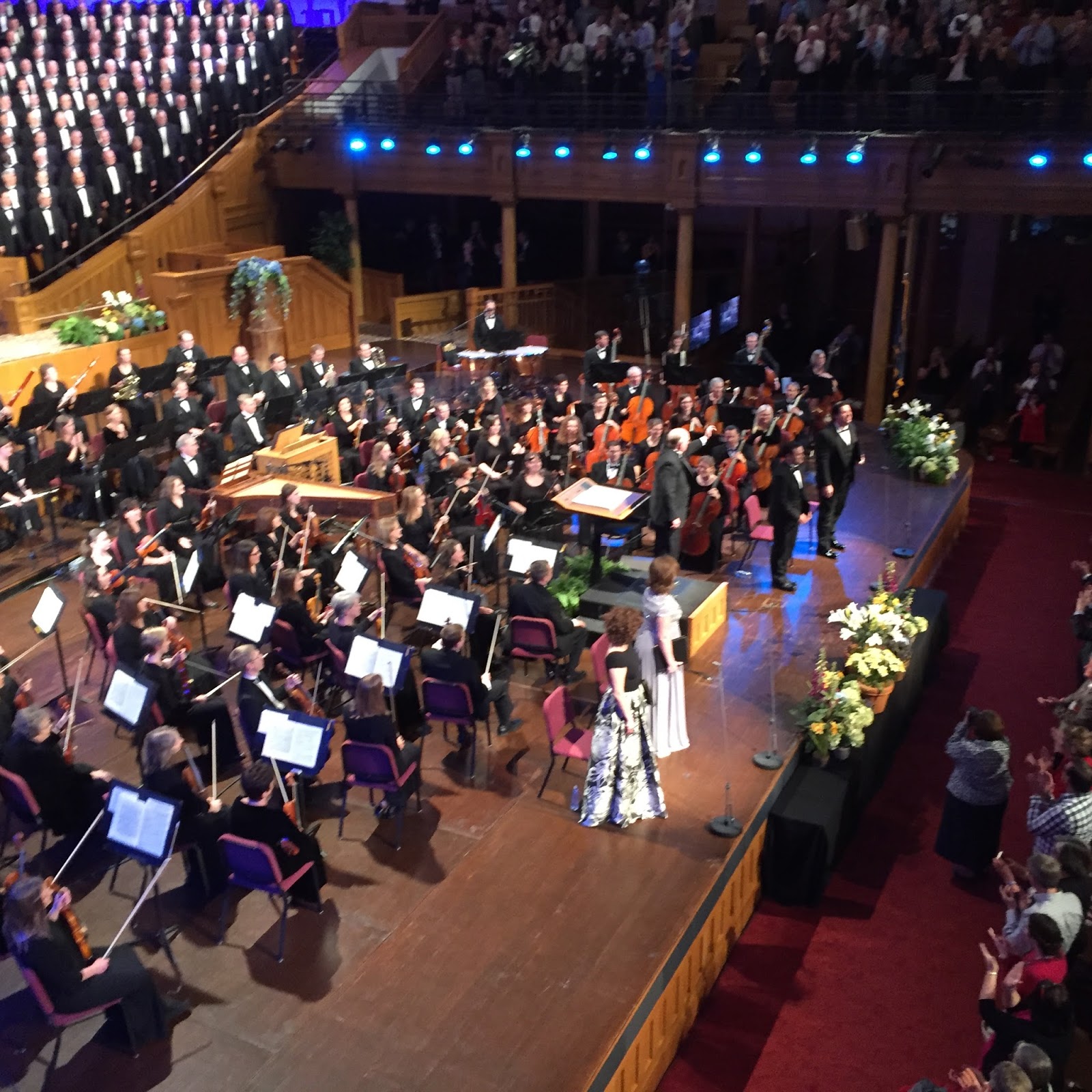
This was my ticket to an extraordinary event on Thursday, March 24, 2016 - The performance by the Mormon Tabernacle Choir, with the Orchestra at Temple Square and some Met opera level soloists, of the entire Handel's Messiah, live in the Tabernacle. It just doesn't get any better than this. I have some history listening to Handel's Messiah (see Messiah Talk ), but I still get goosebumps just thinking about this performance on Thursday.


There were performances both on Thursday and Friday (Good Friday) that were also simulcast at the theaters in the conference center and Joseph Smith Building, and the Friday performance was also "streamed". On demand streaming is still available for a few days at this link MoTab-Messiah . Tickets were made available sometime in February but were sold out within seconds, including tickets for simulcasts overflow areas in the Conference Center and the Joseph Smith Building.

Look carefully. This ticket is to the first performance on Thursday and in the Tabernacle, and it didn't come easy.  On Thursday after a temple session in the Salt Lake Temple and with Evie working diligently in the Family History Library, and being retired and not otherwise occupied, I decided to take a chance in the standby line that forms at the flag pole on Temple Square. It was almost 6 PM and things weren't looking too hopeful. Then a choir member (all dressed up in his tuxedo) came by with 5 tickets and at that time I happened to be number 5 in line. (I had earlier got a ticket from a lady walking by the, but gave it away to a very nice lady visiting Salt Lake from Minnesota so she and her husband could both attend - sort of a "casting bread upon the waters" story.)

Hearing the performance live in the tabernacle was the special kicker for me (you can always buy the Choir's new CD). A performance in the Tabernacle, with its amazing acoustics, is one of the rare, truly "unplugged" musical experiences. There are no speakers or amplifiers or a sound engineer sitting at sound board mixing, modulating, filtering, equalizing and otherwise managing and enhancing the electrons that will come out of the speakers as sound into our ears. Rather, what you hear are the raw vibrations coming directly out of the singer's mouth or the organ pipes or off the violin strings and, after mixing with the other sounds in the rare acoustics of the building, hitting your ear drums. I'm not such a discriminating listener that I suspect in many cases I probably really couldn't tell the difference between this "purely natural" sound and the "electronic" sounds coming out of speakers, but I still revel in the thought of it.

There are, of course, plenty of rock concerts where the sound is loud - so loud you can feel the vibrations, but that is not the Tabernacle Choir/Tabernacle experience. Nonetheless, when the 360 nearly perfect pitch, well trained, disciplined and controlled voices of the choir open up on the Hallelujah chorus, backed by a full orchestra with brass and a timpani and the tabernacle organ and with all those sounds swirled around by the acoustics of that building, it is by no means screeching rock concert loud, but you really not only hear, but feel, the sound. It was marvelous. What was even more remarkable was how beautifully quiet that all those 360 voices could be, even the sopranos singing very high notes, e.g., the opening of "Since by Man Came Death."

Here are a couple of pictures, just to document that I was in fact there (there are a lot of better pictures of the choir and tabernacle).


Note, the orchestra included a harpsichord and some sort of small, baroque like era organ (along with the main tabernacle organ). Mack Wilberg, the choir director, actually re-orchestrated the entire score to more closely correspond to what Handel originally intended, but while also utilizing a large choir and orchestra.  see Mack Wilberg-Messiah


This includes the soloists - all New York Metropolitan Opera level singers and there were all very good. The Soprano - Erin Morley (in black and white dress on the far left if you were looking at them from the audience) is not only a famous opera signer, but also a Mormon originally from the Salt Lake area. Her mother plays a violin in the orchestra and her father at one time sang in the choir.


This is a picture of the orchestra tuning just before the performance. The arrow points to one of the two trumpets in the orchestra. This guy absolutely nailed the trumpet solo on "The Trumpet Shall Sound" - essentially a duet between the bass soloist and the trumpet with the violins playing in the background. I almost got tears listening to it.  I listened to it again on the simulcast on Friday. It sounded much better live in the Tabernacle. So never underestimate what a pudgy, balding, short haired middle aged guy with lousy posture may be able pull off. The choir also did this number again on the Sunday "Music and the Spoken Word" Easter broadcast.

Wednesday, February 24, 2016

The last of the leather booted, cable binding, wood ski, Nordic classic style snow adventurers


Since I retired and we moved to Park City, skiing has once again become a big part of my life, especially since this year there has been a lot of snow in Utah. Since the beginning of the skiing season, I've probably skied more days than I haven't, and just like in Flagstaff,  here it's not really a "project" to go - you can just take off into the hills behind the house.

One problem, however, is the confusion over what I mean when I say I "went skiing." It is not what people think about, especially here in Park City in the midst of world class ski resorts.  The off trail, cross country type of skiing I enjoy so much is really a very small, and likely shrinking, "niche" around here at least.  That's the topic of this blog entry.

It all started in Estes Park in Colorado up near Rocky Mountain National Park where the pictures of Andy and Alisa above were taken many years ago.  There is a reason why Alisa and Andy on skis are not in the same picture. To economize and because I wasn't sure whether they would like cross country skiing, rather than just sledding, I only rented once set of skis, boots and poles for them and made them share - take turns. Although many years ago and well intentioned, I've never been forgiven for doing that (and, really, it was unforgivable -  xc equipment is really pretty cheap to rent). However, the incident is telling in that "cheap" seems to be a reoccurring theme in my skiing.

The pictures are also instructive in two other ways. First, it is not downhill/alpine skiing (which is what most people think of, especially here in Park City, when you mention skiing). This is cross country/nordic skiing with a free heel, a style designed to travel across the snow without or without a trail. As you go your heel is "free" to rise or lift just it does when you walk. In contrast, in downhill/alpine skiing the heel is fixed by bindings tightly to the ski (it can't come up). This provides better control of the skis going downhill and making turns, but makes it difficult to travel uphill or horizontally. I and everyone else in the family downhill ski and we've gone downhill skiing in some pretty nice places, but this blog posting is about the backcountry nordic or cross country skiing I like to do.

Second, while Andy and Alisa are clearly cross country skiing in the pictures, they are not on a groomed trail.  Around here, when folks talk about cross country skiing they are now usually thinking of skiing on groomed trails with two parallel tracks on the sides for "classic" skiers between a wide groomed area for "free style" or "skating" skiers. As depicted in the pictures of Andy and Alisa, we just found a nice place off the road in the national forest and took off across the country. This is the other distinguishing feature of this style of cross country skiing - no need for a groomed trail or resort - just open country.

Family History - Andy's Essay

Our family history of cross country skiing, along with a history of our family moves across the West, is best described in an essay Andy wrote for a college class and is included in a collection of family stories I put together in December 2004. Here is a link to that essay.

Nordic Hyers

The link is to a PDF file on Google drive. I haven't figured out yet how to actually paste a PDF file into this blog.  You should read this story again. Andy gives a nice sense of our family's cross country skiing adventures in the places we've lived, along with some interesting western history.  The picture below is Andy somewhere up near Carson Pass in the Sierras. That area is, among others, described in the essay.


Equipment

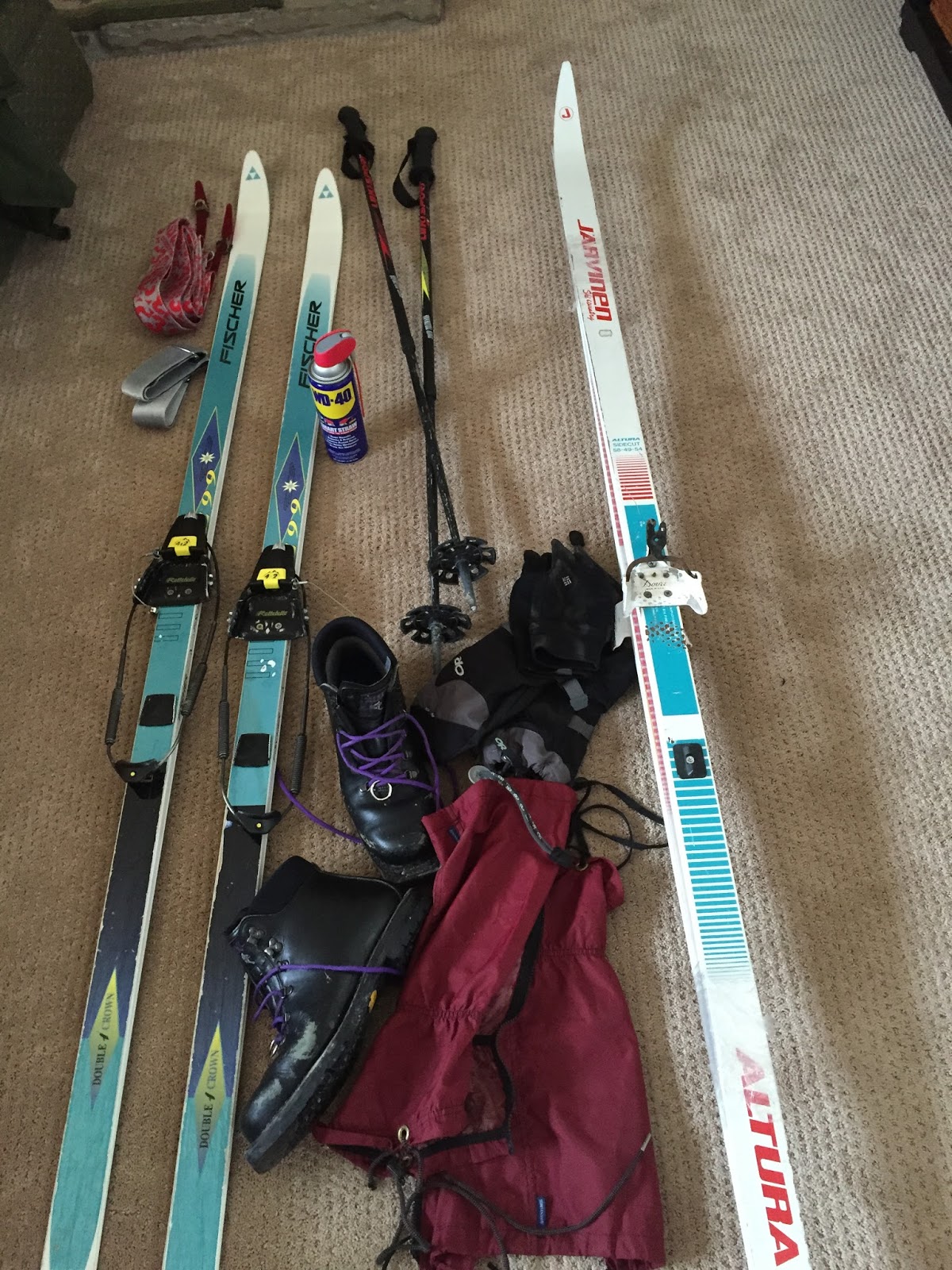
Frankly, as a skier I'm something of an anachronism -  skiing in 2016 on equipment from the 1980s I bought used in the 1990s, but it still seems to work. Here's my gear:


Skis

Let's start with the skis. The skis on the right are the ones I bought in Flagstaff at the time we bought a bunch of skis for the family. The ones on the left, the Fischer E99 Double Crown skis, are what I generally use now. For better control in backcountry conditions, the Fischer E99s have metal edges and are little wider than regular XC ski. They would be considered backcountry touring skis.  I bought the E99s skies as used rentals from a shop in Danville. They've turned out to be great skis for me.

However, you rarely see these skis now in the West, especially in Park City, since folks now are usually looking for skis that turn easily going downhill in deep powder - wide skis with little "camber" (the bow in the ski). (In Park City, the "vertical" aspect of skiing rules over the "horizontal".) However, with the wide ski and little camber you lose the benefit of the "glide" normally associated with XC skiing.  When used with climbing skins you can walk up the mountain on wide skis and, after removing the skins, ski down with bowls with nice turns just like with the now popular wide downhill skis. However, in flat or less steep terrain they don't work all that well, as you have no real glide with those skis. For me a big part of what makes xc skiing fun and efficient is the glide. (If anyone is interested I can explain why this camber, glide, waxless/wax xc ski works.)

With these skis I can go most anywhere in the backcountry - think of going hiking in the winter but with a nice a glide, especially downhill. When I went snow camping (snow caves) with the Scouts (Andy, Dave and Daniel) in California, I was a bit of an oddity skiing in on these skis rather than snowshoes like everyone else. But the skiing was more fun. In my view, snowshoes are for those rare places where it is too steep or wooded to navigate with skis or for those who don't know how to ski.

Bindings

When I bought those skis back in Danville it was really for the bindings (not the skis) and what I really liked about those bindings was that they were not this:


I think everyone in our family grew to hate the three-pin bindings, although they were at that time standard for cross country skis. There were always problems being sure you got the pins set properly in the boot and sometimes you would think you did and you hadn't and the boot would slip out and then the pins would mess up the corresponding holes in the front of your boot. I really grew to really dislike that binding.


While we lived in Danville, Andy and I went cross country skiing in the Sierras and I rented some skis from a ski shop in Danville. The rentals had this Rottefella cable binding (interesting side note: "Rottefella" is Norwegian for rat trap), instead of the 3-pin binding. These cable bindings were a common setup back then for backcountry/telemark skiing. I liked the bindings (or really the absence of the three pins). When we returned the skis, the shop was selling some used rentals and I bought them (skis with the bindings) for $100. It was a very, very good deal. Ironically, nowadays hardly anyone uses a cable binding. There is now the "new nordic norm backcountry" binding and a whole new world of "alpine touring" setups, although the three pin binding is still around and is probably still the preferred "nordic" binding for backcountry skiing.

Boots

Now the boots. At that time the industry had gone almost entirely to boots made from synthetic materials (largely plastic) for backcountry skiing as well as every other kind of skiing and has never looked back. Those boots are stiffer and provide better control than the old leather boots. That's what I got when we rented the backcountry skis that time in California.  Although I don't mind the big, plastic, stiff boots for downhill skiing (and they really work well), I hated them on this cross country ski trip. They made my feet ache and were awkward to walk in. I wanted something a bit more comfortable (even at the sacrifice of skiing performance) and something you could walk around in like a normal person when you didn't have the skis on (say, for example, when you went snow camping with the scouts). I wanted the old fashioned leather boots.

They were hard to find, but I finally found a pair at the REI store in Walnut Creek.  Sitting alone at the far end of a rack with about 15 different styles of synthetic material boots was a single pair of rather forlornly looking leather boots. I bought them. They're great, although I think I'm likely the only person Park City (and probably the western world) still skiing in leather boots (with possible exception of Andy, who got a great deal on some used leather XC/telemark boots in Boise a few years ago and uses them). I suspect now I could find some very comfortable, lighter weight, non leather boots that would likely work better. But getting boots that fit and are comfortable and that are also easy to walk in off the skis can by tricky. Mine still seem to work fine for what I do.

WD40


One early Spring day when we lived in Flagstaff Andy and I went skiing north of town at a little higher in elevation, since the snow near our house was largely gone. It was warm, wet, sticky snow. The trip was a disaster. The snow stuck in huge globs to the bottoms of our skis. It was like trying to ski with a brick on the bottom of the skis that kept getting bigger as you went along. A guy along the trail pointed out that we needed to put some WD40 on the bottom of the skis.  We tried it. It works.

Actually, snow accumulating on the bottom of your skis when the snow is "wet" and the temperature is around freezing (30+ degrees) is a common problem - a real "bane" for XC skiers. If you go into in XC ski shop you'll find a confusing number of different color coded waxes to deal with this and any number of other snow conditions. While WD40 seems to be too much of a "red neck" kind of solution for a sport dominated by sophisticated Europeans and Easterners, it works and is a whole lot simpler (and cheaper) than trying to figure out all those waxing schemes.

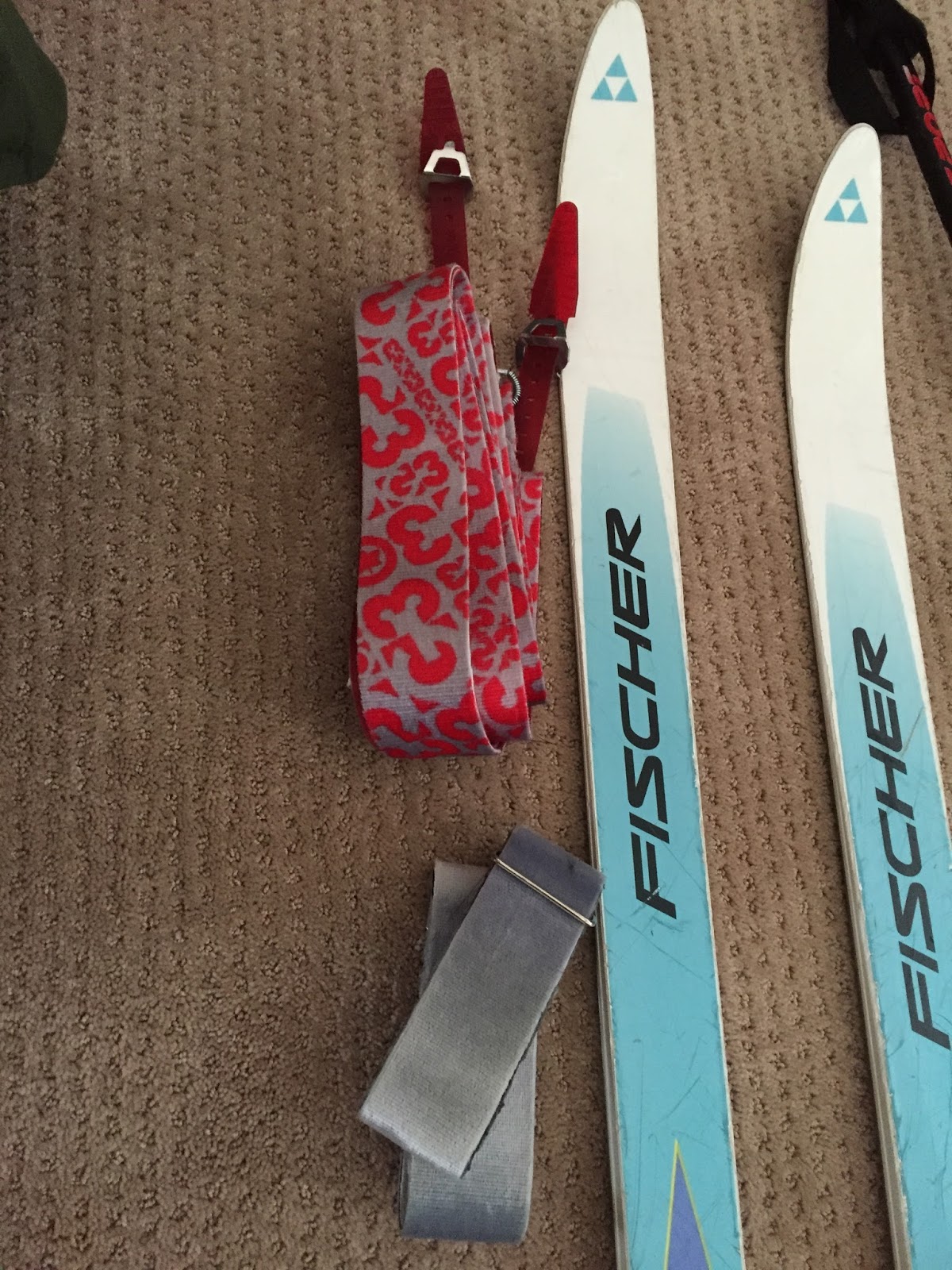
Skins


The climbing skins are new this year and I should have got some years ago. A problem with my style of skiing in Park City is that I'm usually skiing up trails on mountains (typically what would be mountain biking or hiking trails in the summer), not flat terrain or rolling hills. Going up on skis is obviously a problem, since the skis want to slide back downhill. Usually, with herringbone (duck) steps, side steps and careful use of poles I can get up the steep parts of any trail, although it can be something of a scramble. However, the descent can be the greater problem. The trails are usually narrow, often winding through trees, and don't allow for sweeping turns to reduce rate of descent or check the speed. It can be more like skiing down a narrow bobsled run - before you know it you're going way to fast, lose control and crash. Once the trails become packed down or icy, which happens here because hikers in boots or on snowshoes use the same trails, the ascent and descent problems become serious obstacles.

Climbing skins are made of a fabric with tiny fibers pointing rearward to prevent you from sliding backward while allowing you to glide forward. Picture a dog's fur that can be stroked smoothly one way, but stands up when you run your hand the other way. The skins attach to the bottom of the ski by an adhesive and a clip and the top and sometimes another clip at the end of the ski. The adhesive will hold the skin to the ski, but you can then pull the skin off thte ski (without leaving any adhesive on the ski but with the adhesive remaining on the skin) and reuse the skins multiple times.

This winter I bought some "nordic skins" online from a guy in Sun Valley, Idaho for $35. They extend from the tip of the ski to near the middle of the ski just where the "fish scales" section of the waxless ski begins (i.e., they don't extend the full length of the ski). They're the grey ones in the picture above. Andy bought some full length skins for his cross country skis, but then got some wide skins on eBay for his wider telemark skis. Since the narrow skins (red and white above) will fit my skinny skis, he gave them to me for my birthday.

The skins work great and have really changed the experience here. With the skins (especially the full length ones) I can essentially walk straight up the trails with without any slipping back. Also, if the trail is icy or the descent otherwise a problem, I can leave the skins on when going down. You can ski down fine with the skins, they don't really hold you back that much, but they do slow you down a bit on the descent helping you maintain control.

Poles

The poles in the picture above are Leki backcountry poles - a leading German ski pole manufacturer. They were given to me as a birthday present when we lived in California. Also, a year or so ago Evie bought me some Black Diamond hiking poles (so I would stop using hers). She got some bigger snow baskets for them this year. While I may have old junk skis and old fashion worn out leather boots, I have pretty cool poles (Leki or Black Diamond) even among the Park City backcountry crowd.

Trekking on skis - the glide


This is what I really like about skiing here. These pictures are on the mountains above our house. You're off the trail going over routes with for the most part a gentle incline, easy to ski up and when going down you're smoothly moving across the snow with nice long glides in the "classic" style - imagine rollerblading on a moving walkway (like what they have at airports). It's like going for a pleasant walk in the woods, but more fun.

The supremely elegant "telemark" turn


The picture above is no one we know. I just down loaded it from the web to illustrate the telemark turn.

A problem with cross country skiing is making turns. Since the heel is free (not attached to the ski) you don't have the same control over the skis as you do with a fixed heel as in alpine/downhill skiing, making it difficult to turn.  You really can't do the normal "parallel turns" with a carving or "up down" motion used in downhill skiing. 

Many years ago the Norwegians solved this problem with the "telemark" turn (named for Telemark, Norway, which incidentally is where our Hyer ancestors were originally from).  In the telemark turn, the skier moves the downhill ski forward, puts most of the skier's weight on that downhill ski while turning it. The uphill ski, without much weight on it, will just follow the downhill ski around in the turn. The distinctive feature of the turn is the bent knee and raised heel on the following uphill ski. When done well, it is a very elegant turn. 

With improvements in the "alpine touring" ski equipment, which allow the skier to walk up with a free heel, but then lock the heels down for the descent, telemark skiing probably isn't a popular as it once was and is now more of a "niche" sport. Nevertheless, it is a very elegant turn and even today any skier nicely connecting a series of telemark turns will have the respect of everyone on the mountain.

I took a lesson in telemark skiing for an hour or so once in California at Kirkwood. I sort of got the hang of it, but never could do it very well, and my narrow skis with high camber don't make it all that easy to do anyway. On a good day, however, I could probably make the turns in the picture above, albeit with a little less grace. Andy, especially with his wider telemark skis, certainly could.


This is a picture of my tracks of a telemark turn I made this afternoon. Unfortunately, I'm really not very good at it and with age, I'm not likely to get much better.


The picture above is of the tracks of some nicely linked tele turns Andy made on a hill near Ephraim.


I have, however, long since reconciled myself to the fact that I will never telemark ski like the above skier or those in this youtube video of telemark skiing in Utah.
Telemark Skiing - Utah


And you just never know where this all may come in handy